Adventures of an American Seoul-Sister

Adventures and Observations of an American Seoul-Sister

Showing posts with label Food. Show all posts

Friday, September 23, 2011

Chuseok 추석 Food

Chuseok 추석 (pronounced very closely to Chew Sock) is a harvest moon celebration.  It is the most important holiday in Korea.  People return to their home villages to feast and to pay homage to their ancestors by leaving food offerings on family graves.  Children dress in traditional clothing called Hanbok (한복).  Restaurants and stores shut down.  Some places, like the Korean palaces and other places of cultural value, stay open and host special events.  (I'll blog about 한복 and special events on a later post.) 

I had my own little 추석 celebration of Korean food.  Some of it was traditional to 추석 and some not.  I ate on the floor in Korean fashion.

From the top center: Tteokbokki (thick rice noodles in fishy spicy red sauce), Roll Cake, Steak with Sesame Leaves (honestly have NO IDEA how that fork got there--must be Kris's), spicy red bean paste, daifuku (sweet, soft rice cake with black bean filling), and on the plate center: Candied rice cakes, Plate right: Manju (baked pastry with sweet white bean filling), Plate left: Medicine cookies (fried rice cookie).

Traditional 추석 gift in an upholstered woven bamboo case is filled with 추석 sweets, all of which are made of rice.
  This didn't last long in my presence!

Sunday, July 24, 2011

Bento Box

Maybe I have been in Asia too long because I am turning into a bento fanatic!  I got the idea for the nori faces on my absolute favorite Japanese blog http://kunoichijapan.blogspot.com/ which has lots of recipes and other cultural goodies.

Monday, July 4, 2011

Cambodian Food

I had a lovely dinner of traditional Cambodian food.  I don't really know what most of it was, but the meal was presented with each dish in its own banana leaf bowl. 

Monday, April 4, 2011

Fanny

I love this ice cream place called Fanny, located directly across from Hoan Kiem Lake.  It's decorated in Breakfast-at-Tiffany's-esque fashion with neopolitan pink, brown, and cream stripes and Vietnamese girls in pink 50's-diner dresses.  The menu offers several different dishes of thoughtfully prepared desserts.  I have tried a few and plan to go back for more.  Kris thinks the place has a funny name because, of course, eating all that ice cream will give us big fannies!


Top: Banana crepe with whipped cream and chocolate sauce.
Side: Vietnamese coffee
Bottom: Five fruit sorbets atop a fresh fruit salad in a waffle cone with raspberry syrup. 


Strawberry ice cream with blueberry, strawberry, and melon sorbets with fresh strawberries, mint, and a chuck of dark chocolate with chocolate sauce at the bottom of the cup. 


Coconut ice cream served in an avocado with chocolate sauce, whipped cream, and fresh strawberries.


Vanilla and chocolate ice creams with berry sorbet, a chuck of dark chocolate, a white chocolate flower, a pink Pocky stick, and mint atop a bed of fresh watermelon, berries, and dragon fruit salad swimming in chocolate liqueur. 


Tuesday, January 18, 2011

Lost in Translation: Episode 2

Funny foods:


This chocolate is better than crunchy; it's CRUNKY and boy, can it dance!


For My Body: No Sleep Gum because it's good for you like a caffeine overdose, chrystal meth, or cocaine.


Now, here's a truly evolved food brought to you by Darwin:  Dick Stick!  Sounds appetizing, doesn't it?  I mean, who wouldn't want to pop a Dick Stick into her mouth?  Right, ladies?  Ummm...NO!


Sunday, November 14, 2010

Bulgogi: A Tabletop Tour

One of the most common types of restaurants in Korea is the bulgogi restaurant.  Bulgogi is basically thin steak that is grilled at the table.  Here's how it works generally (there is some variation on the table design and cooking arrangements at each restaurant):  First, if the tables are low and diners sit on the floor, they must remove their shoes at the door before walking onto the dining room floor.  The ojossi will bring to some small cups, a bottle of water, and some moist towelettes or washclothes for hand-cleaning.  The center of each table has a small inset barbeque pit for holding hot coals.  Over the coals rests a metal rack.  Over all of this is a metal vacuum tube that sucks away all the smoke.  Marinated raw meat is brought to the table.  Diners cook their own meat on the rack and chop it into bite-sized pieces with heavy-duty scissors so that the meat can be picked up easily with chopsticks.  There is also the option to grill garlic and hot peppers.  The meat is eaten straight from the grill, dipped in spicy bean paste, and/or wrapped in lettuce or sesame leaves.  Along with the meat, a series of side dishes is served.  The side dishes vary depending on the restaurant.  Some restaurants serve a much better display than others.  I went to one the was particularly generous and interesting in its array of side dishes.  Here's a quick video of the arrangement followed by a brief key. 


At the center is meat cooking atop hot coals.

Then clockwise:

Spicy bean sprouts
Shredded cabbage with salad dressing
Kim Chi next to Spicy bean paste
Tiny chilled sea snails (suck on the end to get them out of the shell)
Raw meat in the top left (barely shown)
More spicy bean sprouts
Spicy shredded green onions
Fermented cabbage leaves (not spicy)
Sea lettuce
Lettuce leaves
Vegetable pancakes
Cold seaweed soup

Mashikke tuseyo!

Thursday, November 11, 2010

Pepero Day

While the rest of the world commemorates the day that WWI ended and pays respects to their veterans, South Korea celebrates Pepero day.  What is Pepero Day?  And what is Pepero?

Pepero is essentially a chocolate-dipped breadstick.  The normal size of a Pepero stick is usually a bit smaller than a pencil, but they can get up to the size of a long cigar.  Pepero exists in the USA, but it is sold under the name of Pocky and found in Asian markets and some grocery stores.   


Pepero Day is a commercial holiday invented by Lotte, the makers of Pepero.  Their explanation is that November 11th, abbreviated 11/11, is the perfect day to celebrate Pepero because all of those ones in 11/11 look just like Pepero in a box.  Of course, everyone is reminded of Pepero when they see all those ones on their calendars anyway, so why not make it a special day?  Hmm...  Despite these dubvious connections, their plan seems to be working because Lotte earns 55% of its Pepero sales in the month of November. The boxes range from small packets to boxes of mammoth proportions, and prices ranges from anywhere between 700W (70 cents) to 35000W ($35).

I would liken the holiday to Valentine's Day, only instead of handing out little cards and boxes of chocolate, everyone hands out boxes of Pepero to their favorite people.  Further, most of the boxes are red and are printed with hearts, teddy bears, or pink-bowed puppies.  The boxes even have convenient "To" and "From" spaces printed on them for the purpose of gift-giving.  Luckily, my students adore me.  I have quite a catch of Pepero on which to nibble away my Thursday evening.

Tuesday, October 12, 2010

Un-Fair Food

I absolutely love fairs, festivals, and food.  All of that cotton candy and fry bread is hard to resist.  Korea, however, has its own version of festival faire.  And although I cannot eat most Korean food without dire intestinal consequences, I am still in love with Korean festival food.  First of all, it is so brightly-colored, I am sure that one simple dish could have inspired Manet, Monet, Warhol, and Lady Gaga.  The orange is so orange, and the purple so purple, that the food actually radiates.  If you are like me, the way to your stomach is through your eyes.  I certainly would love to dig into these glowing wonders.  Then, there is the enticeabililty of the strangeness of all this food.  I look at some of the offerings and ask, "What is that?"  Yet, I am sadly aware of Koreans ravinous spice addiction, so I must feast only with my eyes and sample only with my camera.  It's cruely unfair! 

Here's some of the culinary concoctions I can't eat...

An array of spicy seafood, beef, and chicken stirfries.  All of the dishes are orange-red because they are slathered in Korean spicy red paste. 

Food is displayed on tables lining the walkway.  Seating is behind these tables and ordering is done restaurant-style.

 ...some foods I didn't or won't eat...


Green onions and stuffed squid, complete with purple skin, can be eaten like a Hot Pocket.

Pig roasting on a spit (totally edible and delicious) and ribs of some other animal (not edible and quite possibly dog).


Stacks of yummy-looking crabs of questionable freshness.

 
...some foods I could easily eat too much of...
  
 
Candies and cookies sold by the gram.

Roasted chestnuts are everywhere.
 No festival is complete without fry bread--even in Korea!  This guy works hard for his money.


...and finally, a word on beverages:

Caffeine-crazed Americans know to bring coffee with them to Korean festivals.

It's easy to get drunk while hanging out with Russians. 


Drink of choice: Soju (the Vodka of Korea) served in paper shot glasses.
When you've finished, wipe your mouth with a Korean napkin--a roll of toilet paper hanging from the ceiling.

Even though I have difficulties with some Korean food, I certainly encourage everyone (armed with plenty of antacid and an adventurous palate) to try it.  It's dangerous but delicious! 

Thursday, October 7, 2010

Cooking in Korea: Dongchimi

Unable to find any recognizable foods at the grocery store, I find it necessary to learn to cook Korean food.  I cannot, after all, eat Ramen for dinner for the next eleven months.  Whereas the grocer's currently baffles me, I am not at all intimated by the process of learning Korean cuisine.  In fact, I look forward to the day when I can cruise my cart through E-mart and confidently identify more than just the noodles and moon pies. 


I've started with an easy recipe that is a common sidedish for many Korean meals.  It uses a Korean vegetable called mu, which is so huge that it is as long as my forearm and twice as round.  It is a white-fleshed veggie that has a taste and texture nearly identical to the cute little red radishes I am used to.  For this reason, I imagine that this recipe can be duplicated in the states by substituting them for the mu.  If you do use red radishes, don't bother to peel them but wash them very well.
  
The recipe is called Dongchimi.  It's a "cool water," non-spicy kim chi--one of hundreds of kinds of kim chi found in Korea. 

For this recipe I used:

6 TBS Salt
4 TBS Sugar
2 Qts Water
One Mu
One large glass container

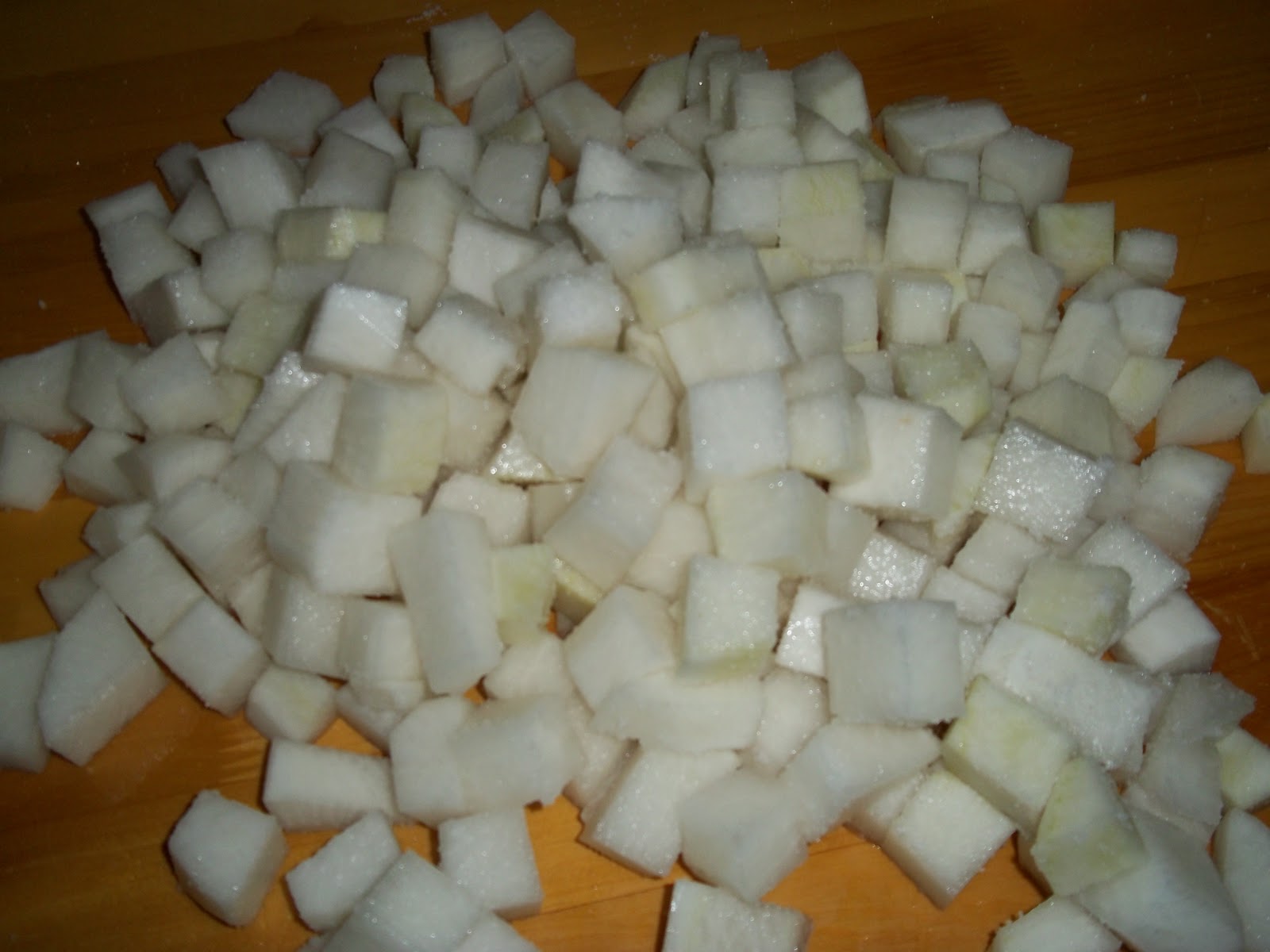
Start by peeling and dicing the mu into 3/4 inch cubes (or one inch long thin slices if preferred)


Sprinkle the mu with 3 TBS of salt and 2 TBS of sugar and toss so that the pieces are evenly coated. 
Put the cubes in the jar, put the lid on, and set aside overnight.


The next day, the mu will be sitting in its own juices that the salt sucked out of the veggie overnight.

Dissolve the remaining salt and sugar in 2 Qts of water, and use this water to top off the jar, covering all of the mu.  Don't fill the jar entirely.  Leave a couple of inches at the top of the jar to make room for the gases that will be released during fermentation.  


Put the lid on the jar.  Set in a room temperature spot for 1 to 2 day until it takes on a vinegary smell. 


Then, refridgerate.  This will last for weeks and weeks!  This is a great recipe for Korea.  It's so humid here that veggies can spoil within a day or two of harvesting.  This may explain why the Koreans have so many varieties of kim chi. Serve this as a sidedish for any type of meat or tofu.  It can also be served with some of the fermented water in the dish.  


Mashikke tuseyo!

Wednesday, October 6, 2010

Cooking in Korea: Roasted Chestnuts

Here's a quick, easy recipe that I was encouraged to try after a student shared her roasted chestnut with me.  In Korea, chestnuts seems to be everywhere: at the grocery store, open-air market, and vended at all the festivals.  In the states, with autumn setting in, they should be popping up in grocery stores very soon.

You don't need an open fire to make these rusty jems.  This is a simple at-home, stove-top technique. 

First, cut an x mark or drill a small hole in each chestnut with the point of a knife.  If you skip this step, the chestnuts will explode during roasting!


Put a layer of water in a pan, and heat the pan on high heat.  Once the pan seems nice-n-toasty, cover the pan with a layer of chestnuts and cover with a lid.


Roast the chestnuts for 10 minutes, stirring once or twice. 

Dump the steaming chestnuts in a strainer, cool, and keep in the fridge for freshness.


To eat, bite into the shell (it'll be soft from the roasting process) to expose the edible flesh.


Roasted chestnuts have a similar texture to baked potatos, and they taste like a cross between a yam and a strong cashew.  Delicious! 


Roasted Chestnuts at the fairgrounds.


Saturday, September 25, 2010

Cooking in Korea: Ojingeochae Muchim

One of the biggest shocks in Korea for me has been the food.  I don't recognize a single item at the grocery store except ramen noodles!  Not a single vegetable is familiar, and besides that, all of the food labels are in Korean. 

So, unable to recognize any foods in the Korean grocery stores, and unable to stomach the spicy-albeit-very-affordable restaurant food, I am inspired to learn to cook Korean food.  I cannot, after all, eat ramen three times a day for the next ten months.

I'm starting with a simple dish that is popular as a lunch box food and is a common sidedish at Korean restaurants: Ojingeochae Muchim.

This recipe calls for:
One pound of dried shredded squid
1/2 cup of Korean spicy red paste
1/3 cup of vegetable oil
1/3 cup of corn syrup or rice syrup
4 cloves of minced garlic
2 TBS sesame oil
Optional: Toasted sesame seeds


1.  Make sure the squid is properly shredded.  Cut it into bite-size pieces if necessary.  Korean kitchens don't often use knives, so use some kitchen scissors for cutting with an authentic flare.

2.  In a large bowl, mix the spicy red paste, veggie oil, corn syrup, garlic, and sesame oil.  It's take a bit of coaxing to get the oils to combine with the paste, but keep at it.  You should end up with a glossy red sauce of even consistency.

3.  Add the squid and mix well, making sure all the squid gets coated with the sauce.


4.  Sprinkle with toasted sesame seeds and serve as a sidedish with bulgogi (Korean barbeque / grilled steak) or as part of a lunch box meal.  Refridgerate leftovers in an airtight container.

Yum!  Chewy and sweet, but not too spicy. 


Since, I'm traveling tomorrow, I've decided to use my ojingeochae muchim as part of a lunch box meal.  My ojingeochae muchim will accompany wild brown rice, sweet clover sprouts, seasoned seaweed snack, and dried jujubes.

 
Stack it all up.  Add a couple of locally-grown apples and some water in my Korean-style water bottle and I'm ready to go!


Mashikke tuseyo!


Sunday, August 8, 2010

Two New Friends, Two Korean BBQs


I have finally stumbled across some English speaking friends with the help of Facebook and Flight of the Conchords.  My new friends John and Nate are also in Chungju to teach English and were nice enough to take Kris and me to their favorite Korean all-you-can-eat BBQ.  The restaurant was a bit shabby, but luckily, this was reflected in the price.  Thankfully, these guys were there to show us the ropes.  Seriously, when you are frying up a piece of bacon and someone hands you a piece of lettuce and industrial-strength scissors, would you know what to do with them?


Not knowing how to eat my food has been a common theme.  Another drawback to graceful dining is not knowing what I'm ordering.  I been using the point-and-hope method.  This usually works well.  However, later the same evening (after already having BBQ for lunch), a misguided point had me eating BBQ again for dinner.  The evening's BBQ was a bit more elegant with all the Korean side dishes included.


Here's how to eat Korean BBQ:  Spread raw meat, garlic and onion slices on the grill above hot coals.  Use tongs to flip the meat.  Use scissors to cut the meat into bit-sized pieces.  Using chipsticks, place a piece of lettuce in one hand and hold it like a tortilla.  Dip pieces of meat into spicy red paste, then place on the lettuce.  Top this with roasted garlic and onions.  Eat like a Korean burrito.  Snack occasionally on side dishes.  Side dishes include: kim chi, pickled radishes, lettuce with salad dressing, green onions in hot sauce, green beans in hot sauce, spinach-like greens in hot sauce, pickled ginger in hot sauce and a extra side of hot sauce.  Everyone eats directly out of the side-dish plates.  They don't portion out bits onto individual plates.  Sharing soup is the same way.   

Wednesday, August 4, 2010

Cultural Exhibit Grabs Some Grub(s)


Saturday, with achy knees and blistered feet, I bought a sweet mint green bike.

Sunday, I rode 10 km south of Chungju-si to Jungangtap and the gardens at the Chungju Museum.  The road featured a wide, slow river on the right and rice paddies on the left. 

Just before the museum was a botanical garden where I got my first glimpse of a lotus garden.  Lotus leaves are about 1.5 feet wide and stand about 6 feet tall.  From the garden, I saw an old Korean man bent over the river's edge gathering some local delicacy from ankle deep mud.  The garden path led me along the river to Jungangtap.  Jungangtap is an ancient pagoda atop a mound.  It was originally built to mark the center of the kingdom.  Now, it's the center of a sculpture garden and several roofed platforms where families picnic.  The museum itself had some cool pottery and a couple of old hanbok (traditional dress) but was otherwise lost on me as it was entirely in Korean. 

Hungry and thirsty (it's very muggy here), I went to grab some grub.  I entered a small cafe where my best attempt at placing an order was to shrug my shoulders at the waitress.  She brought a fried corn pancake with veggies, kim chi, and rice wine.  In the cafe, I was approached by several Koreans who wanted to take pictures with me and offer me maps of Chungju.  Appartently, I was one of the exhibits because, like everywhere else I've been so far, I have been a muched-stared-at cultural oddity.  Still hungry, I went to an outdoor vender that was selling skewered meat and toasted grubs.  The grubs tasted like nuts. (-: