South Korea has some interesting traits, many of which I really liked. Here's my top 10 (in no particular order).
1. Color has no gender. Boys and men wear pink, ride pink bicycles, carry pink backpacks... It doesn't make them girly. It's no big deal.
2. Hand-holding with friends is okay and quite common. You needn't be boyfriend and girlfriend to hold hands. It's quite normal to hold hands with any friend at an time. Even boys hold hands or cuddle affectionately at any given moment.
3. No gym membership required! Almost every park is outfitted with exercise equipment, including different weight and stretch machines. My favorite of these is the walking path paved in squishy, impact-absorbing material like on a professional running track. No joint damage during jog time!
4. Radiant floor heating. As in traditional Korean homes, the standard (assuming it is in operational order) is to heat the floor through a system of hot water pipes running under the floor boards. Since heat rises, this makes wonderful sense. Plus, my cat really liked all the warm spots that this generated on the floor.
 |
| Moomarelli stretched out on a warm spot on the floor. |
5. Seaweed and mushrooms are available in several varieties and are inexpensive. Some of the mushrooms available at a Korean grocery store I've never even heard of, and some are available in the US for expensive "gourmet" prices. Back in the USA, I was a wild-harvester of seaweed and really love to eat it. So, I was very happy with the variety of seaweed available in stores. And, talk about cheap! A pack of 10 nori sheets goes for about $5 stateside, but in Korea $5 will get you 100 sheets.
6. Coffee and pasteries. Yum! Nearly every other business in South Korea is a coffee shop. The trick is the pick one that is not too expensive. At some shops, the price for a single latte can be as much as $6.00. Yikes! To go along with that cherished cappucino, French pastries are abundant. Many bakeries feature French-style goods and sport names like "Paris Baguette" and "Tous Les Jours."
7. Vintage clothes are easy to find in used clothing stores. In Seoul, you'll pay a pretty penny to purchase vintage and retro, but in smaller towns like Chungju, you can purchase a vintage dress or sweater from $2 to $10.
8. Hanbok. I love folk clothing and the hanbok is no exception. This lovely dress comes in vibrant colors and is positively charming. Almost everyone has a hanbok. However, it is also true that hardly anyone wears it aside from very special occasions like traditional weddings. Hanbok shops are everywhere! Used hanbok go for $5 childrens and $25 adult. New hanbok are a couple hundred dollars. Colors are chosen according to age, status, employment...
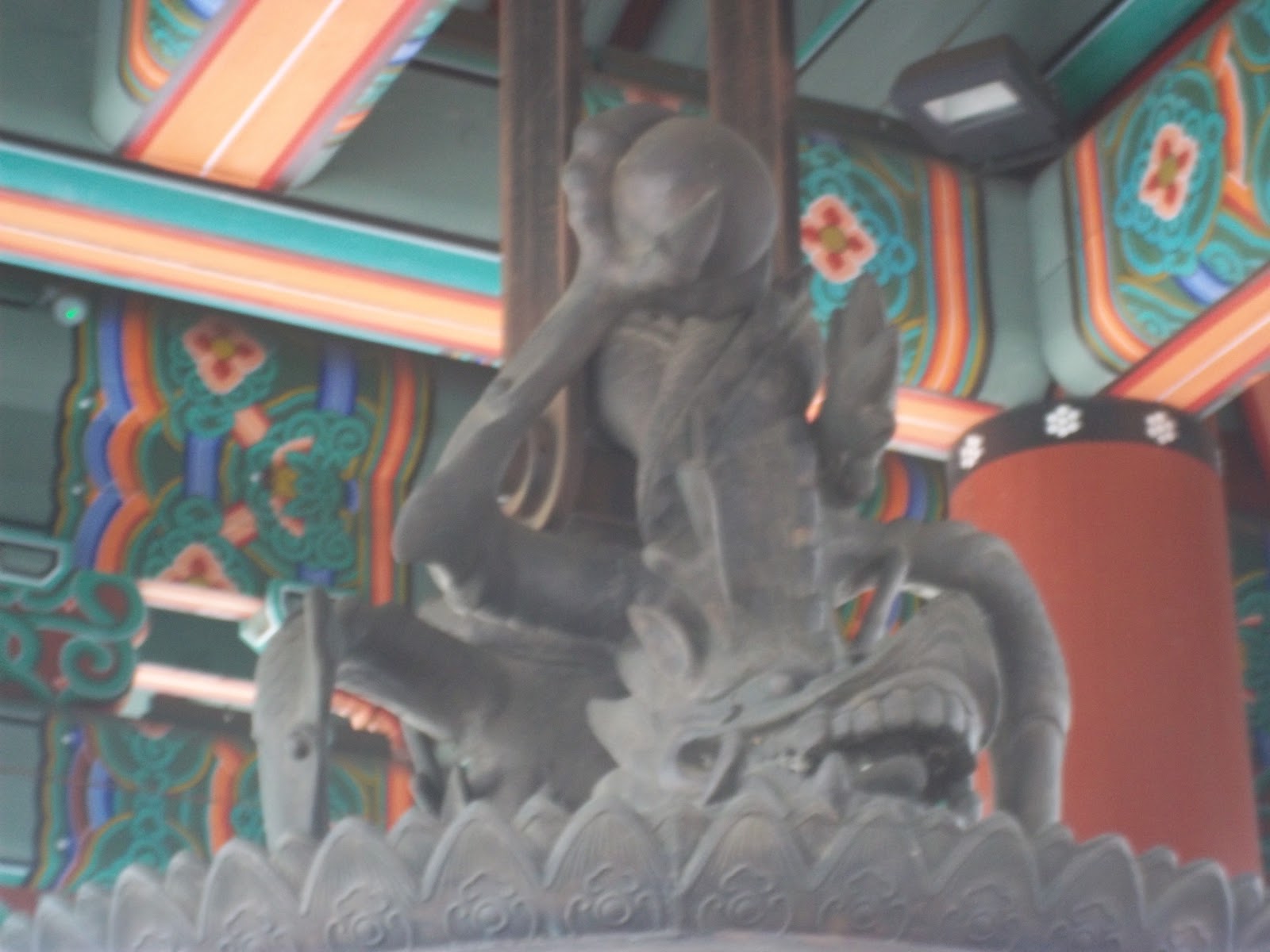
9. Buddhist temples painted in vibrant colors. The eaves and ceilings are painted with such detail! The most common themes for the eaves are flowers, chickens, and dragons. The carved doors are painted in bright teal on the outside and lined with paper on the inside to allow light to pass through and create beautiful shadows.
 |
| Notice the chickens? |
 |
| Door from outside. |
 |
| The same door from inside. |
10. Lotus gardens. The lotus is a much larger flower than I had thought.
 |
| Lotus leaves are as large as my torso, and the flowers are about the size of my head. |